I want closeness more than anything, and it can also feel unsafe, so I swing. Here is why your nervous system steps on the gas and brake at the same time—and how to find steady ground.
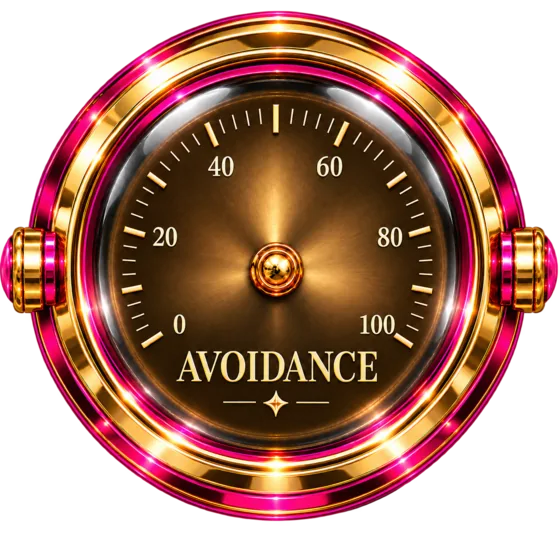
Anxiety Dial: High (≥ 3.56)Avoidance Dial: High (≥ 2.92)Core Vibe: Magnetic Push-Pull
Having both dials elevated does not mean you are "impossible to love." In psychological science, fearful-avoidance (often researched in childhood as disorganized attachment) develops when the people who cared for you were also unpredictable or a source of fear. Your brain learned to crave love while keeping your sneakers tied to run. That pattern kept you safe then, and it can change.
THE UNDERLYING MECHANISM
"I want closeness, and it can also feel unsafe, so I swing."
Attachment science calls this Approach-Avoidance Conflict. You crave profound, soul-level intimacy with electric passion, but the exact split-second someone gets close, your alarm screams: "TRAP! THEY WILL BETRAY OR HURT YOU!"
So you pull back or push them away. But the moment they step back, your anxiety screams: "THEY ABANDONED ME!" So you chase them back. It is like driving a car with your foot stomping on the gas and the brake at the exact same time.
The Specialized Adaptation
Dual-Field Vigilance. Simultaneous threat and distance tracking. Unmatched intuitive capacity to read hidden power dynamics, unvoiced agendas, and relational fault lines.
The Systemic Tax
Severe nervous system gridlock, somatic exhaustion, dissociation, and intense shame cycles.
The Graphic Novel Episode
Two Voices Through One Wall: The Wardrobe
I knew both of my mother's voices before I was six. One sang me to sleep. The other came through the wall an hour later.
If I stay very still, she'll be the singing one in the morning.
On those nights I took the torch into the wardrobe and sat on the cold floor under the coats, bending wire into little people until the house went quiet. I was not hiding from a stranger. I was hiding from the person who had just sung to me.
Researchers call it fright without solution. When the safe place and the scary place are one person, the body learns to reach and flinch in the same motion.
A torch in the wardrobe, hiding from the voice that sang them to sleep. When safe and scary share one face, reaching and flinching are learned as one motion.
About me: Fright without solution: reach and flinch in one motion
Coach's notes
“Rule #1 of a frightening childhood: you learn to love with one foot already out the door.”
— Vesper (looking back at 27)
Disorganised/fearful attachment follows caregiving that is frightening or frightened, so the caregiver is at once the source of safety and the source of alarm: fright without solution (Main & Hesse 1990; Liotti 1992).
Reach and flinch are learned together; the adult runs approach and avoidance at the same time.
The Oscillating Needle: Six Hundred Square Feet
My studio is six hundred square feet on the fourth floor of the Russell in Detroit, eight hundred a month, month to month, one of about a hundred and forty.
Freight elevator, concrete floor cold enough through bare feet to wake me up, and the whole building humming like a thing that used to make car parts. I build kinetic mobiles: brass beams, weighted spheres, steel wire. To make one float you have to hold tension and release in your hands at the same time and respect both.
People buy them because they look calm. They are not calm. They are two forces that have agreed on a number.
A brass sphere set on a beam and let go. A mobile floats because two pulls agree on a number. Their hands know that balance; their wiring runs both pulls.
About me: Two forces that have agreed on a number
Coach's notes
“Fearful-avoidant wiring: you want to be held tight enough to stop shaking, and you want enough room to launch a rocket. At once.”
— Vesper (Studio Sketchbook)
Mikulincer, Shaver, Bar-On & Ein-Dor (2010): Relational ambivalence reflects concurrent activation of approach and defense systems, providing exceptional sensitivity to complex, contradictory interpersonal dynamics.
Dual-vigilance channeled into kinetic synthesis; Warnock (2024) and Taylor (2015) confirm structured pacing stabilizes high-conflict affective states.
The Oscillating Needle: Two Forces
I set a sphere on the end of a beam and let go. It dipped, swung, settled. The whole piece breathed once.
Attachment people call my wiring dual vigilance: the anxious dial and the avoidant dial running together. Most people feel one side of a moment, the pull or the risk. I get both, every time, in the chest and in the hands.
It is exhausting on a Tuesday with a new person. It is also why nobody else in this building can make brass float like this.
Fingertips letting a sphere go, feeling the dip and the settle. Most people feel a moment's pull or its risk. This wiring registers both, in the chest and the hands.
About me: Dual vigilance: both dials active at once
Coach's notes
“Two dials pinned at once is not a fault in the gauge. It is a lot of information.”
— Coach Hype
Concurrent activation of the approach and defence systems: relational ambivalence gives heightened sensitivity to contradictory interpersonal dynamics (Mikulincer, Shaver, Bar-On & Ein-Dor 2010).
Both dials active: the pull and the risk register together.
The Oscillating Needle: The Best Night
Julian came over on the Tuesday with a record he had talked about for a month. We never got off the floor.
Julian
Thank you for telling me.
We ate cold noodles out of the box. He put his hand flat on my sternum while I was talking and left it there. At 3 AM I told him about the wardrobe. The torch, the wire people, both voices. I had never told anyone.
He said thank you for telling me, and fell asleep on my shoulder like it was nothing. I lay there with my arm going dead and thought: this is the best thing that has happened to me. Know that before the rest of it. That is what it looks like when a person receives you instead of inspecting you.
Julian asleep on their shoulder, the wardrobe finally told. Being received instead of inspected is the best thing that has happened, and the hangover is sized to it.
About me: How good it was, before the rest of it
About them: Received, not inspected: 'thank you for telling me' and nothing added
Coach's notes
“Nothing after this makes sense unless you understand how good that night was.”
— Coach Hype
Responsive reception of self-disclosure deepens attachment and raises the stakes of exposure; in fearful adults the same event triggers the defence that follows (Mikulincer & Shaver 2016).
The intimacy is the cause of the hangover, not a contrast to it.
The Oscillating Needle: Gas and Brake
By 8 AM I wanted to be dead, which is a dramatic way to say I woke up and the whole thing had turned.
They know too much. If I let them closer they'll trap me. If I push them away I'll die alone.
His text was sweet. 'Woke up smiling about last night. Can I see you tonight?' My stomach dropped into a cold hole and my hands locked around my knees on the kitchen floor.
Both pedals at once. The gas: I want him here now. The brake: he knows everything now, he has the whole file, he can do anything to me. They call that ambivalence. The body calls it a freeze with the engine screaming.
Hands locked around the knees on the floor after a sweet text. Wanting him here and fearing what he now knows fire together; two pedals at once is a freeze.
About me: Ambivalence: the gas and the brake
Coach's notes
“Driving with the gas and the emergency brake both down is how a gearbox explodes. That is a Wednesday for a disorganised nervous system.”
— Coach Hype
Disorganized/fearful states represent concurrent activation of attachment proximity-seeking and defense threat systems.
The instinct is always the same. Blow the bridge before anyone can walk across it.
I sat on the brass stool with my jaw tight and my thumbs cold on the glass and wrote the thing I always write. 'I don't think we're looking for the same thing. Let's keep our distance.'
It was not true. It was never true. It is a sentence that takes the knife out of his hand and puts it in mine, and for the length of time it takes to type it, I am not the one who is going to get left. On his side it will land as a verdict with no trial, the morning after the best night of his too.
Cold thumbs over the draft that ends it. Blowing the bridge before anyone can cross it puts the knife in their own hand: while they type, nobody can leave them.
About me: The vulnerability hangover: burn the bar down so you never go back
About them: On his side the message lands as a verdict with no trial
Coach's notes
“A vulnerability hangover is your brain the morning after your truth, telling you to burn the bar down so you never have to go back.”
— Dr. Adair Jenkins
Pre-emptive rejection serves as a defense against anticipated relational betrayal in high-anxiety, high-avoidance dyads.
Impulse to detonate relationship indicates peak vulnerability hangover.
The Two Days: Sent
I sent it at 8:41 in the morning.
Coach Hype
It worked. Say what it got you.
Ten minutes where nobody could do it to me first.
Coach Hype
And on his side, those ten minutes were the start of two days of not knowing what he did.
For about ten minutes it was the best I had felt since the record stopped. My breathing came back. My hands went still. I put the phone face down and cut a length of wire and the studio was mine again, and nobody in it knew about the wardrobe.
If you have sent that message, you know this part and nobody ever says it out loud: it works. For ten minutes it works. That is why we keep doing it. The floor comes after.
A phone laid face down, a hand already on the wire. The cold message works, for ten minutes: breathing back, hands still. That relief is why it keeps getting sent.
About me: Pre-emptive rejection: the only control on offer, for ten minutes
About them: My ten minutes were the start of his two days of not knowing what he did
Coach's notes
“Pre-emptive rejection is not self-sabotage in the moment. In the moment it is the only control on offer.”
— Coach Hype
Defensive strategies persist because they deliver immediate relief from attachment distress even when they damage the relationship (Fraley, Vicary, Brumbaugh & Roisman 2011; Mikulincer & Shaver 2016).
The relief is real and short, and it is what keeps the pattern alive.
Two Days
He answered at 9:12. 'That's hard to read after last night. I'm not going to argue with you. I'm here when you want to talk.'
I read it maybe forty times in two days. I blocked him on Wednesday night and unblocked him at 2 AM. I worked twenty hours on a commission I did not have. I sliced the base of my thumb on a wire end and did not stop. I did not answer.
Every hour that passed made answering more impossible, and every hour I was more certain that the silence now was his, not mine, which is a trick my head has done since I was six. He did the one thing that lands on someone like me: no fight, no chase, a door left open with no clock on it.
Blue tape dark around one thumb, twenty hours of wire. Blocking and unblocking at 2 AM is both pulls at once, and every silent hour makes the reply heavier.
About me: The hours make the message heavier, then unanswerable
About them: Safety plus space: no fight, no chase, a door left open with no clock on it
Coach's notes
“The hours do not make it easier. They make the message heavier and then they make it unanswerable.”
— Coach Hype
After a self-initiated rupture, fearful adults oscillate between approach and avoidance (blocking and checking); the delay increases perceived cost of repair (Mikulincer & Shaver 2016).
Every hour of silence makes the reply heavier, which produces more silence.
The Two Days: The Proof
Thursday, 4 AM, sat against the workbench on the concrete with my thumb bleeding through the tape.
Coach Hype
'I am the thing that ruins it.' Say the whole sentence. I am not leaving the floor.
Six.
Here is the whole of it, and I believed every word. I always do this. It is not fear, it is me. Something in me is wrong at the root. The only reason anyone stays is that they have not seen it yet, and now he has, so this is the part where it comes true. I made him go so I could be right.
If you are at 4 AM with your own version of that: I am not going to tell you tonight that it is not true. I am going to sit on the concrete with you.
Back against the bench on the concrete at 4 AM. 'I am the thing that ruins it' feels like proof. It is a story made true by leaving first.
About me: The belief at 4 AM: I am the thing that ruins it
Coach's notes
“Deep validation does not argue with the belief at 4 AM. It stays on the concrete until morning.”
— Coach Hype
Fearful attachment pairs a negative model of the self with a negative model of others: the person expects rejection and believes themselves unworthy, so withdrawal is read as confirmation (Bartholomew & Horowitz 1991).
After sabotage the belief is not 'I was scared' but 'I am the fault', and the evidence is self-made.
The Vulnerability Hangover: Bleeding Off the Speed
At some point I knocked the brass Newton's cradle on the bench and the spheres started up. Click. Click. Click.
The pendulum doesn't stop by crashing. It stops by bleeding off speed.
I watched it bleed off speed. Not stop. Bleed. Each swing a little shorter, the clicks further apart, and somewhere in there my breathing went with it without asking me.
That is rhythmic entrainment: the body borrowing a beat from outside until it can hold its own. It did not fix anything. It got me from 4 AM to the part of the morning where you can make tea.
The cradle clicking, each swing a little shorter. The body borrows a beat from outside until it can hold its own. Not a crash; a bleeding off of speed.
About me: Rhythmic entrainment: borrowing a beat until you can hold your own
Coach's notes
“When both dials are pinned, do not make decisions. Watch something with a rhythm until your heart matches it.”
— Vesper (Studio Note)
Rhythmic sensory entrainment regulates autonomic nervous system arousal during disorganized dysregulation.
Externalizing rhythm allows nervous system to safely downshift.
The Center Line: What Julian Said
We met on Saturday at the coffee place on Russell Street, and I had the whole apology rehearsed, and he went first.
Julian
I didn't leave. You left, and then you waited for me to prove the story.
He said: 'I wasn't going anywhere, and I think you decided I was. You said the distance thing, then went quiet for two days. I kept thinking, this is somebody doing a thing to themselves, and I don't know how to be useful while it happens.'
Then he said the one that took the floor out. 'I didn't leave, Vesper. You left and then waited for me to prove the story.'
Two cups on a cafe table, his hands flat beside them. He never left. They left first and waited for him to prove the story, while he stood there confused.
About me: I left, then waited for him to prove the story
About them: The person you pushed is usually still standing there, confused
Coach's notes
“The person you pushed is usually still standing there, confused, holding their coffee.”
— Coach Hype
Withdrawal and pre-emptive distancing are experienced by the partner as the withdrawer's exit; the partner often remains available while the withdrawer predicts abandonment (Körner et al. 2026).
The prediction creates the evidence it then cites.
Finding the Center Line: The 25 MPH Pacing
So I told him the truth at a speed I could survive, which is the only version of honesty I can actually deliver.
'That message was not about you. I get a hangover after I let someone see me, and it tells me to end things first. I want this. I need to go slower. Thursdays, and I will tell you when I am in it instead of disappearing.'
He said, 'Thursdays is fine. Tell me when you are in it, even if it is just the word.' Coaches call it graduated pacing: the fear out loud at twenty-five miles an hour instead of the guardrail. The fear said out loud, with his name kept out of the blame, is a thing he can hold; a cold message is not.
The phone in hand again. Fear said out loud at twenty-five miles an hour, his name kept out of it, is something he can hold. A cold message is not.
About me: Graduated pacing: the fear out loud at twenty-five miles an hour
About them: The fear said with his name kept out of the blame is a thing he can hold
Coach's notes
“Earned security is not having no fear. It is telling your person the fear without making them the monster.”
— Vesper (Closing Note)
Graduated pacing breaks the oscillation between hyperactivation and deactivation, allowing relational safety to consolidate.
By the next Thursday the Newton's cradle had not moved in three days, which for this bench is a record.
My phone was face up next to it and I had not flipped it over once. I put my hand flat on the warm wood between the two of them, the still brass and the quiet phone, and left it there.
Both dials are still in me. The pull and the risk came up this morning about a text that said 'coffee?'. The difference is I know what they are, and I can keep my hand on the bench until the needle finds the middle.
A hand flat on the wood between a still cradle and a quiet phone. Both pulls are still in them; naming them is what keeps the hand on the bench.
About me: The needle at rest: two forces telling each other the truth
Coach's notes
“The needle at rest is not the absence of force. It is two forces finally telling each other the truth.”
— Vesper (Studio Note)
Earned security: adults with difficult early attachment histories who have developed coherent, integrated accounts of them function securely in adult relationships (Pearson, Cohn, Cowan & Cowan 1994).
Both dials named aloud and held: the fearful system consolidates safety.
The Center Line: Both Hands
It is March. We are still going. I have sent one more cold message since, a smaller one, on a bad Sunday, and I told him within the hour what it was.
That is the whole change. Not fewer alarms. A shorter gap between the alarm and the sentence that says: that was the hangover, not me, and I am still here.
I still build things that only hold still because two forces are pulling on them. I know exactly why that is what I make. An hour of not knowing he can carry. Two days he could not, and he told me so.
Both hands steadying a mobile that hangs level. The alarm still fires. What changed is a shorter gap between the alarm and the sentence: that was the hangover, not me.
About me: A shorter gap between the alarm and the sentence
About them: An hour of not knowing he can carry; two days he could not
Coach's notes
“You do not stop being a person with two dials. You get faster at saying which one just moved.”
— Vesper (Final Note)
Attachment representations change gradually; in practice the measurable change is in the speed and presence of repair, not the absence of the defensive impulse (Taylor et al. 2015; Fraley et al. 2011).
The alarm keeps firing; the gap between the alarm and the sentence gets shorter.
Real Telemetry & Statistics
Population Prevalence: ~3 to 5 percent of adults operate primarily with fearful-avoidant attachment (Bartholomew & Horowitz 1991; Hesse & Main 2000).
The Drama Myth: It is often mislabeled as "toxic" or "chaotic," but it is simply a nervous system that learned that closeness and danger came from the same source. Trauma-informed co-regulation melts this pattern.
Workplace Mechanics:Impostor Freeze. Swings between brilliant, passionate burst performance and sudden terror of criticism. Can misread neutral constructive feedback as a total personal betrayal.
Allostatic & Leadership Volatility: Preoccupied and fearful employees experience nearly double the daily subjective stress of secure peers (Whitehall II cohort). In leadership, high dual insecurity can trigger unpredictable "executive reset" cycles (hot-and-cold shifts), destroying team psychological safety.
Evolutionary & Career Telemetry
Psychic Counterbalance: The Dual-Vigilance Navigator
The hidden power of holding two opposing poles—and the high-complexity callings where your electric depth uncovers truths others miss.
Research on relational ambivalence (Mikulincer, Shaver, Bar-On & Ein-Dor 2010) reveals that carrying elevated anxiety and avoidance simultaneously generates Dual-Vigilance. While single-dial individuals perceive situations unidimensionally, the fearful-avoidant mind maps the entire contradictory landscape: profound intimacy potential alongside systemic risk and structural vulnerabilities.
CLINICAL PACING SCIENCE
Graduated Pacing Over Impostor Freeze (Taylor 2015)
Warnock et al. (2024) identify that high dual-insecurity can induce "impostor freeze" under ambiguous organizational stress. However, meta-analyses by Taylor et al. (2015) demonstrate that attachment anxiety decreases and relational safety stabilizes when individuals utilize graduated pacing and rhythmic sensory entrainment (like Vesper's Newton's cradle), replacing volatile whiplash with steady operational rhythm.
Ideal Vocational Callings
Kinetic sculpture and fine art (like Vesper), international hostage and crisis diplomacy, systemic organizational risk auditing, trauma recovery mediation, investigative psychological profiling, avant-garde music composition, and high-stakes conflict reconciliation. Domains where simple binary thinking fails and holding high-voltage contradictions is required to find breakthrough solutions.
THE COUNTERBALANCE PRINCIPLE
Cruising At 25 MPH (Without Erasure)
The objective is never to flatten Vesper's rich, electric emotional depth into bland conformity! The fearful-avoidant creative fire is an extraordinary asset. The goal is moving off the whiplash extreme (accelerating to 100 MPH passion and crashing into an emergency brake cutoff) into graduated deceleration at 25 MPH. Transparent pacing disclosure keeps relationships safe without sacrificing creative intensity.
Workplace Narrative & Tactical Charm
The Client Escalation: From Executive Reset to Dual-Safety Cadence
In a high-profile museum installation, sudden scope volatility triggers acute approach-avoidance whiplash. Here is how Vesper prevents the Executive Reset and leads with dual-safety clarity.
THE HIGH-STAKES SCENARIO
The 48-Hour Scope Overhaul
Two days before opening night, the museum board demands radical structural changes to Vesper's kinetic sculpture installation. The fearful-avoidant system experiences an immediate double bind: high attachment anxiety craves artistic validation, while high avoidance experiences the last-minute intervention as an existential threat of control. Heart rate climbs past 100 BPM into physiological flooding (Gottman & Levenson 1985), prompting the classic Executive Reset: an overwhelming urge to cancel the entire exhibition or burn professional bridges to escape vulnerability.
EMPIRICAL NEURO-DYNAMICS
Dual-Safety Framing & Somatic Deceleration
Warnock et al. (2024) identify that high dual insecurity creates vulnerability to impostor freeze and volatile resets under organizational ambiguity. Clinical models by Taylor et al. (2015) confirm that rhythmic sensory entrainment and graduated pacing stabilize dual-vigilance. By instituting Dual-Safety Framing (coupling an explicit 20-minute somatic time-out with a guaranteed return time), Vesper allows prefrontal executive circuits to reclaim command from subcortical panic.
REACTIVE REFLEX (THE EXECUTIVE RESET)Approach-Avoidance Burn
The Scorched-Earth Ultimatum
"These requested changes compromise the entire engineering integrity of the exhibition. If leadership cannot respect our signed contract, I am pulling the kinetic sculptures off the gallery floor right now."
The Cost: Destroys institutional reputation, burns long-term patronage, and leaves Vesper isolated in creative distress.
"The board's new criteria introduce significant mechanical variables forty-eight hours out. To ensure our installation maintains structural safety and museum-grade presentation, I am stepping away from the floor for twenty minutes to review the schematics. We will reconvene at 2:30 PM sharp to lock our final execution sequence together."
The Leverage: Combines sovereign boundary setting with dependable continuity, maintaining high artistic standards while honoring collaborative accountability.
If-Then Implementation Intention (d = 0.65): If unexpected project turbulence spikes my heart rate above 100 BPM during an escalation, then I will call a 20-minute operational recess, announce my exact return timestamp, and engage rhythmic sensory grounding before issuing any directive.
The Blister Pack: Navigator Tool Objects
1. The Unanswered Messages
A phone with four incoming messages: Hey..., Are you ok?, Miss you, Can we talk?
2. The Newton's Cradle
A small brass Newton's cradle: watching the swing slow down until the body slows down too.
3. The Hooded Vest
A black hooded vest with a broken-heart patch: armor zipped up before anyone gets close.
4. Vesper with Her Phone
Vesper lying back with her phone in one hand and the other hand at her mouth.
THE EARNED SECURITY HABIT MOVE
"Deceleration at 25 MPH"
Instead of accelerating to 100 MPH passion and crashing into a sudden cutoff, take relationships at 25 MPH. When the vulnerability hangover hits, make this shift:
❌ The Whiplash Move: Picking a sudden fight or cutting off contact before they can hurt you.
✅ The Deceleration Pause:"My nervous system is feeling overwhelmed because I care about this so much. I'm not pulling away from you—I'm just going to take three slow breaths so my feelings can catch up to my head."
The Rel8r Bundle: every Pocket Guide firebreak, offline on a phone, Why Do They Go Quiet? in two editions, and an offline copy of the Attachment Compass. $39 USD once, no subscription. 30-day refund, no questions.